


FIP World Padel Report 2026 is online. More than 40 million players, courts up by 20% and a new study on economic impact: €8.6 billion in GDP
October 14, 2026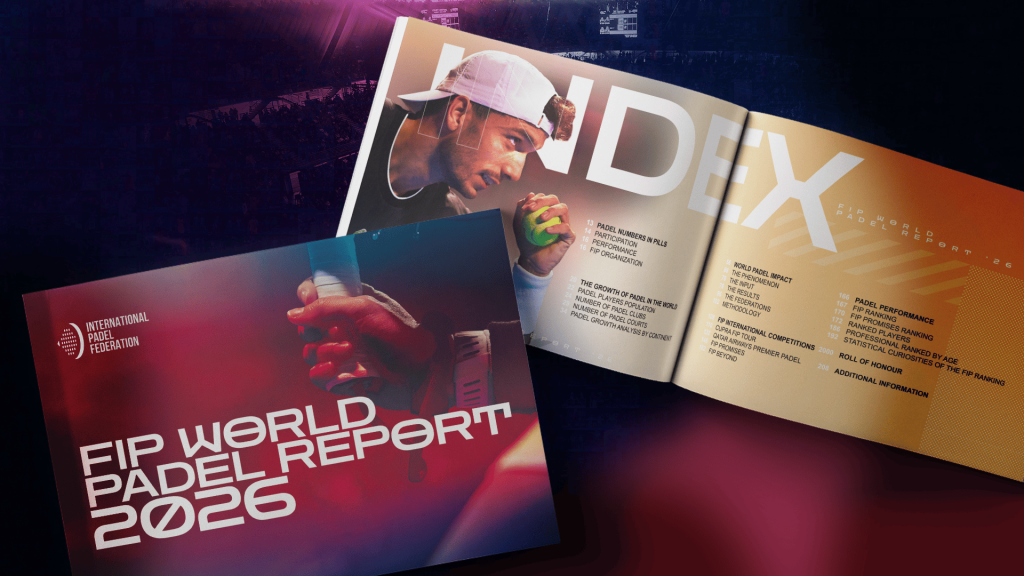
- Carraro: “The Report gives us a picture of a global sport that continues to expand. Young talents are the perfect bridge between the extraordinary grassroots base of the sport and the professional game”
- The major and eagerly awaited new feature of the Report is the ‘FIP World Padel Impact’, a study of the global padel industry. The global padel industry generates almost €7 billion in annual expenditure
- The report also includes the FIP International Competitions and FIP Ranking sections, offering an overview of the development of the four circuits governed by the International Padel Federation, as well as player profiles and statistics
More than 40 million active players worldwide. Annual growth in the number of courts of over 20%. And there is more: padel generates €8.6 billion in GDP, with every euro spent on our sport generating €1.26 in GDP. These are just some of the most significant figures to emerge from the 2026 edition of the FIP World Padel Report, the study available from today on the www.padelfip.com website, produced by the FIP Research & Data Analysis Department.
One of the main new features of the FIP World Padel Report 2026 is the ‘World Padel Impact’, an economic study carried out in collaboration with OpenEconomics. This extensive, in-depth study analyses the economic impact generated by padel in different countries through five key parameters: court rental value, construction of padel facilities, technical equipment, tournaments and total expenditure by country. Annual expenditure generated by the global padel industry amounts to €6.84 billion, with €13.07 billion in economic output and more than 235,000 jobs. The economic analysis can be downloaded from the FIP website and is also available through a dedicated interactive mini-website, which allows users to explore the study’s findings in greater detail. In addition, each FIP-affiliated federation has its own dedicated profile, presenting the contextual data underpinning the analysis and the economic impact generated.
“FIP World Padel Report 2026 once again gives us a picture of a sport experiencing strong and continuous expansion – said FIP President Luigi Carraro –. The number of male and female players, clubs and courts is increasing, as is the number of countries where our sport is played and National Federations supporting its development. The amateur game, which represents the extraordinary foundation of our sport, continues to grow, while professional padel is also expanding, becoming increasingly international and competitive, and reaching new audiences and markets. There is a fundamental bridge between these two dimensions: young people and emerging talents. Investing in the next generation means building the future of padel. The 2026 edition – FIP President continued – also introduces an important new feature: World Padel Impact, a chapter specifically dedicated to studying the economic impact generated by padel around the world. This is another step towards understanding our sport and its development, because padel today is not only a major sporting and social phenomenon, but also an ecosystem capable of generating investment, employment, infrastructure, tourism, events, innovation and new economic opportunities. Measuring this dimension”, Carraro concluded, “means gaining an even better understanding of what padel has become and, above all, of its continuing potential. FIP World Padel Report 2026 tells this story through data, analysis and trends. But behind every figure there are people, passion and an international community that continues to grow. And this, more than anything else, is the measure of padel’s extraordinary growth around the world”.

Now in its third edition, the report analyses the continued global growth of padel through a series of key indicators, including the number of players, clubs and courts, the sport’s geographical expansion and the development of international competitions. There are now more than 91,200 courts, almost 14,000 more than a year ago (+20.4%), while the number of clubs has increased by 3,890 compared with the FIP World Padel Report 2025. Padel is played in 191 countries and independent territories, 21 more than last year, with 100 FIP-affiliated federations and 1,110,000 registered players (+30.5%). Compared with previous editions, the “Growth of Padel in the World” section includes a more detailed analysis of the sport’s development at continental level, identifying key trends and charting the evolution of padel in different parts of the world.
The FIP International Competitions section then provides an overview of the history and development of the four FIP circuits: CUPRA FIP Tour, Qatar Airways Premier Padel, FIP Promises and FIP Beyond, with detailed statistics on the number and growth of tournaments, expansion into new countries and continents, and player participation and development. While 290 FIP tournaments were held across 50 countries in 2025, 434 tournaments have been confirmed for 2026, across 62 countries.
Finally, the FIP Ranking section provides a comprehensive analysis of the men’s and women’s rankings, with information on players and their respective nationalities, as well as a specific focus on the Top 100 and Top 300. A dedicated subsection also explores interesting facts and statistical data relating to the rankings, including players’ average age, years of birth and other characteristics of the player population in the FIP Ranking.


