Online the FIP World Padel Report 2025, a comprehensive analysis of a sport in constant growth
December 2, 2025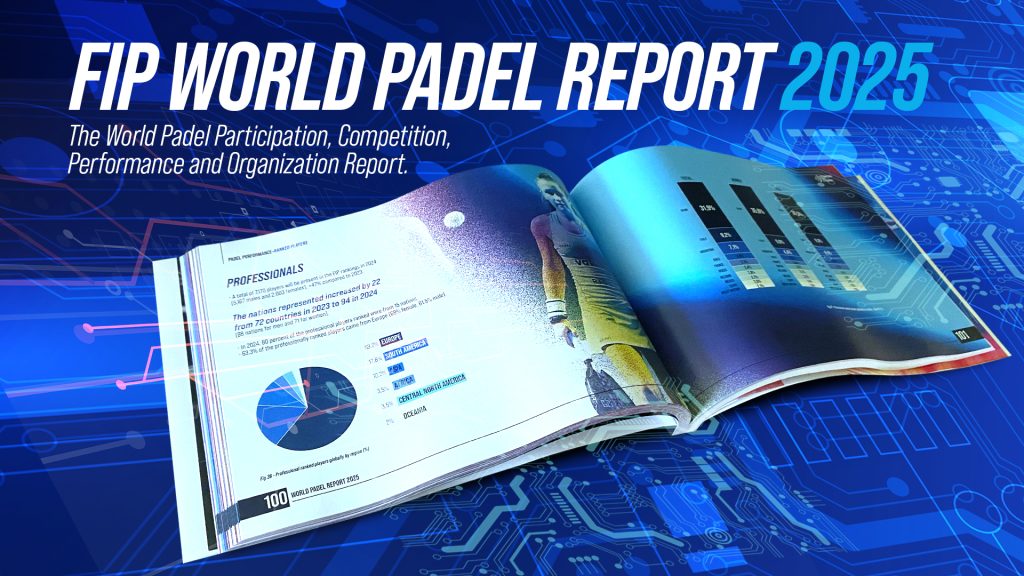
- The number of active players has surpassed 35 million: +16.1% clubs, +15.2% courts, +42% registered federation members.
- Significant growth of padel also on the web and social media: 70 million page views on the website, over 800,000 followers on FIP channels.
- Inside the document, new sections dedicated to curiosities and statistics about players and national teams.
Over 35 million players, a 16.1% increase in clubs, a 15.2% rise in courts, and a 42% growth in members registered with national federations compared to last year. The second edition of the FIP World Padel Report – an analysis of FIP activities presented during the General Assembly in Acapulco (Mexico) and produced through the FIP National Federation Survey 2025 – highlights the global growth of padel. The FIP World Padel Report 2025 is available today on the official website padelfip.com.
This development of padel spans all five continents, thanks also to initiatives that increased the number of FIP-organized tournaments from 182 in 2024 to 290 in 2025, involving over 11,000 athletes – both women and men – featured in the professional and junior rankings of the International Padel Federation. The global facilities map shows that clubs have increased by 4,775 units, surpassing 24,600; 14,355 courts were built in 2025, bringing the total to 77,300, spread across 150 nations and 20 dependent territories (+26 compared to the FIP World Padel Report 2024).
The section on participation, in addition to illustrating through analyses and charts the strong global growth compared to the previous report – regarding the countries where padel is played, the number of amateur players, and the number of clubs and courts – introduces a new chapter that examines growth at the continental level. It highlights, for each region, the countries experiencing strong growth, emerging countries, and those in a consolidation phase.
In the chapter on competition organization, readers will find both the history and statistics of the three FIP circuits – Premier Padel, CUPRA FIP Tour, and FIP Promises – as well as the roll of honor of world competitions (professional, junior, and senior) by nation and by pairs in the various categories.
The performance section includes an analysis of the FIP men’s and women’s rankings for both professional and junior players, plus a new chapter dedicated to statistical curiosities about top players: from their birth cities to the heights of the best athletes, the year of birth with the highest number of Top 100 and Top 300 players, and the Under-21 and Over-35 athletes who achieved the best rankings in 2024.
The second part of the report, produced by the FIP Research & Data Analysis Department, includes profiles of each of the 87 national federations affiliated with FIP in 2025. Starting next year, national associations will also be added, bringing the total to over 100. This section also includes the number of coaching licenses and the number of national participations in the various international team competitions.